
Not By Sight - When We Have to Walk By Faith
Updated: Feb 5
Scripture:
“For we live by faith, not by sight.”
— 2 Corinthians 5:7
Additional reading: Jeremiah 17:9 · Hebrews 11:1 · Psalm 42:11 · Hebrews 13:5 · James 1:2–4 · Galatians 6:9 · John 14:15
Intro:
Letting go of control can feel impossible.
Trusting God when you don’t know the outcome can be terrifying. We want clarity. We want assurance. We want to see where we’re going before we take the step.
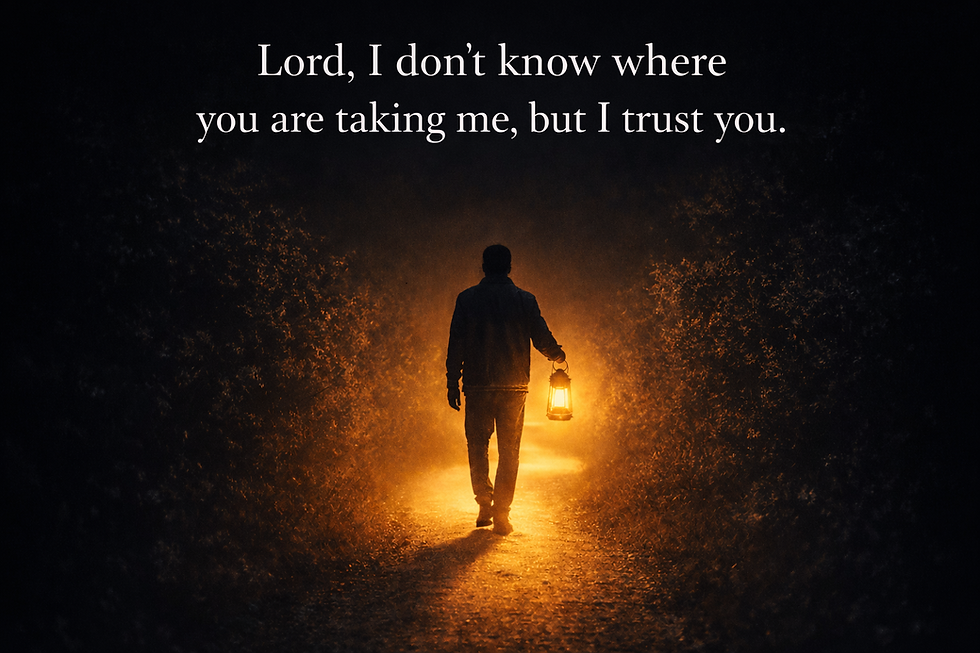
But Scripture tells us plainly: we are not called to live by what we can see. We are called to live by faith.
And faith often begins where sight ends.
Trusting God When We Are uncertain of Outcome
Walking by faith does not mean pretending fear isn’t real. Fear is real. Feelings are real. But Scripture is clear: feelings are not reliable guides.
“The heart is deceitful above all things and beyond cure. Who can understand it?” (Jeremiah 17:9)
This is why the popular advice to “follow your heart” or “listen to your heart” is not just unhelpful—it is dangerous. The heart can justify sin, excuse compromise, and convince us that disobedience is wisdom when God says the opposite.
Faith is not trusting your emotions.
Faith is trusting what God has said.
Hebrews 11:1 reminds us that faith is confidence in what we hope for and assurance about what we do not see. That means faith often feels uncertain. It often feels uncomfortable. Even the most faithful men and women in Scripture struggled emotionally.
David cried out in despair.
Elijah collapsed under exhaustion.
Jeremiah wept in loneliness.
Paul wrestled with weakness.
Scripture never teaches that feelings determine God’s presence. God Himself promises, “Never will I leave you; never will I forsake you” (Hebrews 13:5). His nearness does not rise and fall with your emotional state.
Faith grows strongest in dry seasons.
James tells us that trials produce perseverance, and perseverance matures our faith (James 1:2–4).
In silence, in discomfort, in the wilderness, God is not absent—He is deepening us. The desert strips away emotional dependence and replaces it with spiritual roots.
Galatians 6:9 reminds us not to grow weary in doing good. God sees your obedience. He sees your perseverance. He honors faithfulness that continues even when the reward feels far away.
Obedience matters more than feelings.
Jesus Himself said, “If you love me, keep my commands” (John 14:15). Love for God is not measured by emotional intensity, but by obedience when motivation is low and the heart feels empty.
Faith chooses God—no matter the circumstance, no matter the outcome.
Heart Application
Start your day with truth, not emotion.
Speak God’s Word over your feelings.
Obey even when motivation is low.
Keep showing up.
Give thanks—especially when it’s hard.
And remember this: God does not change when your emotions do.
Trust His goodness.
Reflection Questions
In what areas of your life are you relying more on feelings than on God’s Word?
What obedience is God calling you to, even if it feels uncomfortable or unclear?
How might God be deepening your faith through a season that feels dry or silent?
Closing Prayer
Lord God,
Help me to walk by faith when I cannot see the way forward.
Teach me to trust Your Word above my emotions,
to obey even when my heart feels weary,
and to believe that You are working even in silence.
Strengthen my faith in dry seasons
and anchor my life in Your unchanging truth.
I choose to trust Your goodness.
In the name of Jesus, Amen.


Comments